
We love to measure things. Whether it is tracking the amount of coffee we drink to kickstart our mornings, recording every workout on our Apple Watches to see how many calories we burned, or checking the Weather App to see if the temperature of the afternoon heat wave has eased before an evening run, measuring things is an essential part of our daily lives.
But how do we approach measuring an abstract notion such as independence? Moreover, measuring something as particular as Central Bank Independence (CBI)?
The notion of central bank independence itself is a tricky one. A government creates an entity (often a central bank or a monetary authority) to oversee the domestic economy and regulate the value of its currency. The government prescribes certain policy goals as their objective, and attributes varying degrees of freedom to pursue these objectives through statutory legislation. Essentialy, the notion of “independence” is how freely a central bank can pursue its monetary policy objectives without outside interference from the government or other special interest groups pressuring the central bank to follow a certain course of action.
However, as we know, the government has its own vested interests in the economy. Every election cycle, we hear the babbles of those running for election: “I will fight to expand the middle class!”, “I am committed to brining gas prices and grocery prices down!”, “Inflation would have never reached such heights under my administration!”
Sometimes, we see government officals, often those in the Oval Office, testing the waters of this so-called independence. President Nixon was known to invite then-Chair of the Federal Reserve Arthur Burns to the White House to pressure him to implement easy monetary policy to stimulate the economy and boost presidential ratings. More recently, the Federal Reserve fell prey to the wrath of the infamous Trump Tweets, with Jerome Powell and the Federal Reserve getting their fair share of a presidential temper-tantrum down their backs.
How is CBI Measured?
The notion of CBI has been established for a while now in political and economic circles; however, understanding how to quantify legislation that measures CBI puzzled economists for decades. It wasn’t until 1992 when Cukiermann, Webb, and Neyapti pulled data from 1950 to 1989 to create the very first index of CBI (known as the CWN CBI Index)2 based on 4 essential categories:
- the appointment and turnover rate of the governor of the central bank,
- the objectives of the central bank (a bank with a sole mandate for price stability would rank the highest),
- the limitations of the central bank to lend to the government,
- a policy formulation cluster, such as the central banks say in the budget process and resolution of conflicts between the executive branch and the governor of the banks.
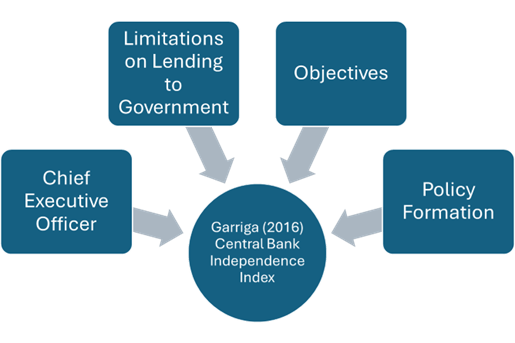
Crickets were chirping for the next two decades until economist Ana Carolina Garriga, a professor at the University of Essex, made an enormous leap forward in developing the CBI Index. Garriga expanded the dataset3 by obtaining primary sources for 179 countries and coded over 840 documents- constitution, laws, amendments, and decrees that directly refer to central banks and central bank charters. Legislation was mainly collected from online sources and coded in four independent processes, and it was coded for all countries that had available texts in English, Spanish, French, Portuguese, or Italian. She also included her own unique variables, including central bank creation, a central bank reform that affects CBI each year, its direction (CBI increase or decrease), and whether the central bank is a regional entity. The dataset includes 6,764 observation for central bank reforms and indentifies 382 reforms affecting CBI.
Figure 1: Component of the Garriga (2016) Central Bank Independence Index
In the spring of 2020, the Covid-19 pandemic blindsided the world. During this period, a new era of central banking began which included radical monetary policy, expanded balance sheets, and a revamped approach to forward guidance. However, in many countries, the concept of central bank independence was strained as governments pressured central banks heavily. Given the changed nature of central banks, it was time for a new index.
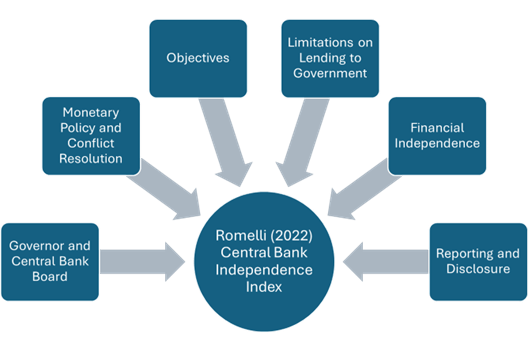
Davide Romelli, an Associate Professor in the Department of Economics at Trinity College Dublin, recoginzied the need for a modified index that better represents the concepts of CBI. He created the Romelli CBI Index (2022)4 which captured modern central banking in a new light, including key variables that captured their role in fincancial markets and transparency with the public. Below is a figure showing the components of the Romelli CBI Index.
Figure 2: Components of the Romelli CBI (2022) Index:
Romelli’s contribution to economic literature was monumental. He captured the evolved nature of central banks in a tumultuous time and allowed us to better understand the monetary institutions that are often shrouded in mystery.
What’s Next?
Elvira Nabullina, the current governor of the Russian Central Bank, made a bold declaration, “I believe that being in a position, as a central bank, to influence economic growth does not mean losing independence.” 5
This quote, muffled under the heavy suffocating blanket of Russian bureaucracy, shows that this idea of independence from government influence is strong among the global community. Certainly, as the dynamic relationship between government and central banks evolves over time, central banking and the notion of independence will certainly be discussed in the coming years. Understanding the notion of independence will lay the foundation for future developments and bringing together policy and public as central banks continue to have a crucial role.
Appendix:
Works Referenced:
- Featured Image for this article was generated by ChatGPT. Citation: OpenAI. (2024). Measuring Central Bank Independence. (generated by ChatGPT). Retrieved from OpenAI’s ChatGPT.
- Cukierman, Alex, Steven B. Webb, and Bilin Neyapti. (1992) Measuring the Independence of Central Banks and Its Effect on Policy Outcome. The World Bank Economic Review 6:353-98.
- Garriga, A. C. (2016). Central bank independence in the world: A new data set. International Interactions, 42(5), 849-868.
- Romelli, D. (2022). The political economy of reforms in Central Bank design: evidence from a new dataset. Economic Policy, 37(112), 641-688.
- Elvira Nabullina, Governor of the Central Bank of Russia, made this quote during the International Economic Forum in St. Petersburg on June 3, 2016.

 Econothoughts
Leave a comment