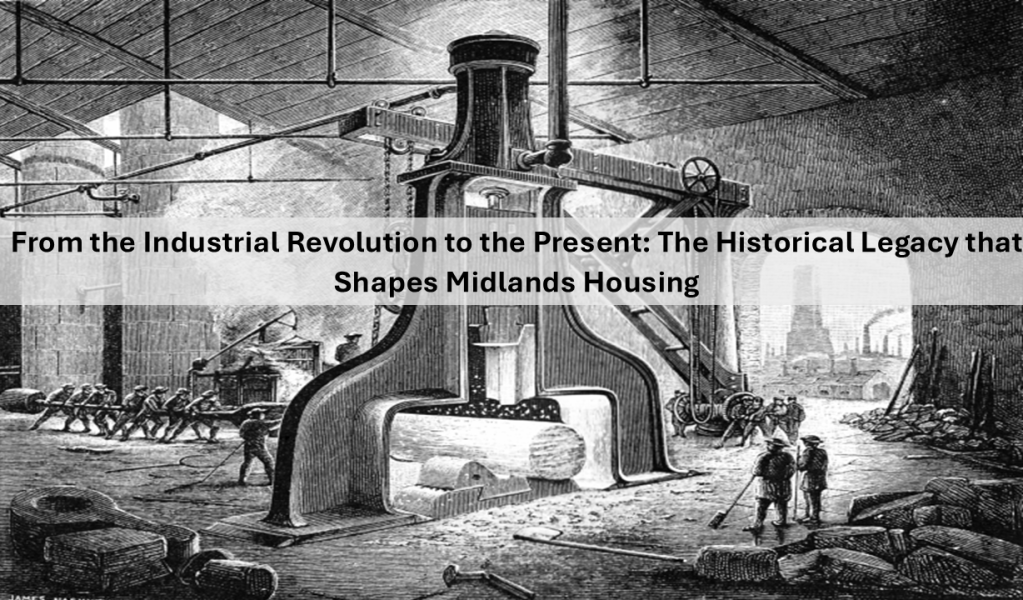
Source:The Industrial Revolution and STS – Science Technology and Society a Student Led Exploration
Introduction
The roots of housing inequality in the Midlands stretch back to one of history’s defining moments, the Industrial Revolution. Though the revolution carved prosperity into Britian’s economy and propelled the nation to become the world’s economic superpower, the regional scars left behind by Britian’s industrial past continue to shape the spatial inequality seen today. Using the Index of Multiple Deprivation (IMD) 2025, I examine how historical patterns of industrial concentration continue to shape structural housing barriers across the Midlands. Despite the rapid de-industrialization that occurred in the Midlands in the 1980s, the legacy of the Industrial Revolution persists in shaping Midlands’ housing and the geography of social deprivation in post-Industrial Britain of today.
How the Industrial Revolution Shaped Housing in the Midlands
The Industrial Revolution was borne in the Midlands in the 1760s as a result of technological innovations structurally transforming the nature of the British economy from a more agrarian and local economy to a system of factory production through mass industrialization. Workers left their traditional rural agricultural work and began to migrate closer to the factories and populate urban centers. The four Black County regions of Walsall, Dudley, Sandwell, and Wolverhampton saw vigorous industrialization, while Nottingham and Leicester in the East Midlands began to see rapid growth as well. However, rapid urbanization led to mass construction of poor housing structures (creating mass worker ‘slums’) and weak city planning. Diseases, such as cholera, were rampant and claimed thousands of lives, while homes were highly pollutant, dirty, and often times unsafe. The government in Parliament was slow to respond, and it wasn’t until the mid-1800s when the state began to have an interest in housing due to the mounting public health concerns.
The Public Health Act of 1848, enacted in response to the massive cholera outbreak due to poor sanitation and workers’ conditions, was the state’s first attempt at legislation to mitigate the social burns and public health challenges imposed by the Industrial Revolution. However, a significant breakthrough wasn’t seen until the Public Health Act of 1875 when local authorities were given explicit powers to regulate sewage, waste removal, and drainage of highways and streets. The beginning of the 20th century and the conclusion of WW1 saw the 1919 Housing and Town Planning Act passed which provided subsidies for local authorities to build council houses, and the following decade of the 1920s brought about the era of cheap credit and rapid construction of housing[NS1] . The Wheatley Housing Act of 1924 allowed the central government to provide subsides for social housing and by 1933 over half a million homes were built.
The Post World War II Resurgence of the State’s Interest in Housing
The outbreak of WWII in 1939 temporarily halted government initiatives to further housing development. After the conclusion of the War, the scale of destruction of London, Coventry, and Liverpool as a result of the Luftwaffe bombings placed housing back on the forefront of the state’s interest. The government of Prime Minister Clement Attlee set to deliver a “Homes for All” programme including mass housebuilding and the development of new towns outside existing cities. Over a million new homes were built between 1946 and 1951, with 80% of homes being government-subsidised council housing. Nearly two decades later, the 1980 Right to Buy Scheme under Prime Minister Margaret Thatcher changed the approach to housing undertaken by previous governments. The Right to Buy scheme enabled local authority tenants to buy their home at a discounted rate, however; it ultimately led to the depletion of the stock of social housing available. The legislation paved the way for greater housing inequality, regional disparities, and pronounced intergenerational effects. Yet, despite these national legislations and decades of efforts to dismantle structural housing barriers inherited from Britian’s Industrial past, the entrenched regional inequality in the Midlands persist in the shadow of the Industrial Revolution.
The Scars of the Industrial Revolution Are Still Seen Today
Figure 1: Overcrowding & Affordability by Midlands Local Authority
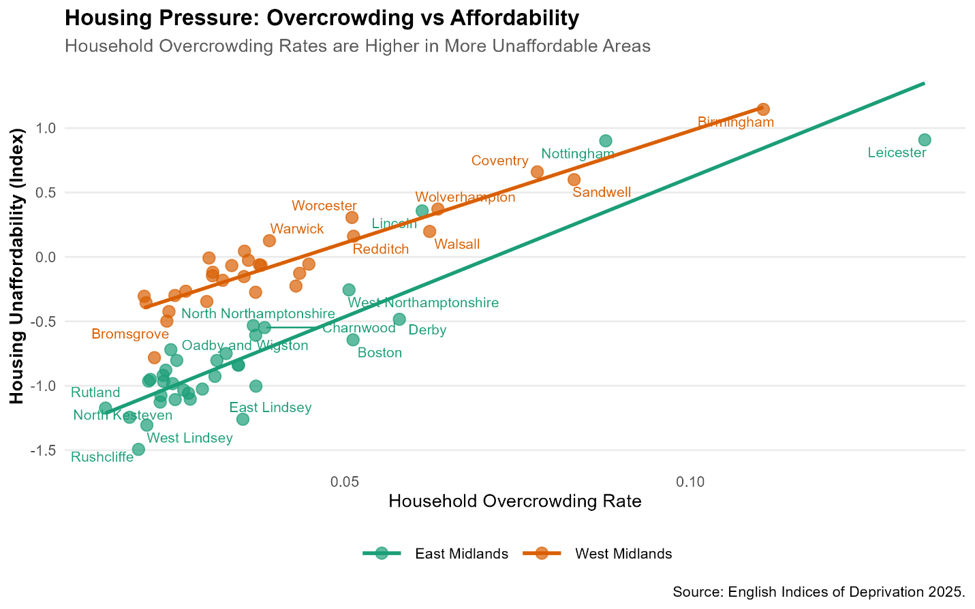
Using data from the English Indices of Deprivation Barriers to Housing Domain, Figure 1 plots the Household Overcrowding Rate against Housing Affordability Index (housing affordability is defined as the relative difficulty in accessing the private rental market or owner-occupation). Local authorities with more negative values represent relatively more affordable housing, while local authorities with positive values represent less affordable housing. The data also shows that heavier urbanization is also linked with higher household overcrowding rates (e.g. Nottingham, Birmingham, and Leicester). All three urban centres saw considerable growth and industrialization during the Industrial Revolution. Birmingham transformed into an industrial hub and a key transportation hub due to its network of canals, meanwhile Leicester would be known for its cloth working. Nottingham incorporated elements of both cities and would be known for its Lace Market during the Industrial revolution. The intense urbanization and population growth of the 18th and 19th centuries created spatial constraints, dense urban layouts, and a large stock of ageing housing which does not measure up to current household standards. The current housing conditions not only reflect the housing dynamics of the current housing market, but also reflects the long term ‘scarring’ effects of history industrial growth and high-density settlement continuing to constrain housing supply.
Similarly, the cluster of the Black County regions in of Sandwell, Walsall, and Wolverhampton, regions that saw heavy industrialization during the Industrial Revolution, experience less affordability and more overcrowding rates than their Midlands peers. When housing becomes less affordable, households respond by sharing accommodations across generations and residing in smaller dwellings. Likewise, higher overcrowding rates affect key Social Determinants of Health (SDOH), including child poverty. According to Department for Work and Pensions, estimates show that in 2024, Wolverhampton and Walsall saw 38% and 36% of children aged under 16 living in relative poverty, respectively, while 38% of children under 16 live in relative poverty in Sandwell and 30% of children under 16 in Dudley. The historical patterns of industrial concentration continue to intersect with spatial inequality seen today. However, the social burden is not spread uniformly across the region, as local authorities were impacted differently over time due to variations in historical development. Figure 2 (see below) groups local authority areas by similar patterns of deprivation observed from the IMD Living Environment Domain across local authorities.
Figure 2: The Geography of Social Deprivation in the Midlands (2025)

Examining the sub-components of the IMD 2025 Living Environment Domain at the local authority level, I implement Principal Component Analysis (PCA) to reduce the dimensionality of the deprivation indicators and identify 3 principal (main) components that explains the largest variance across the Midlands authorities. I then apply K-Means clustering to group local authorities based in their deprivation profiles. In other words, each cluster shows local authorities that exhibit a similar pattern deprivation, whether it be Air Pollution, Poor Housing Conditions and Energy Stress, or Traffic-Environment tradeoff. My findings show that the scars of the Industrial Revolution are still seen in the spatial deprivation seen across the Midlands.
The orange grouping represents local authorities whose main deprivation is Poor Housing Conditions and Energy Stress. Nottingham, Leicester, Coventry, Birmingham, and the surrounding Black County, all areas which saw incredible urban transformation during the Industrial Revolution, display high deprivation regarding housing as much of the housing in these highly urbanized local authorities was constructed in the 19th century or in the post-WWII reconstruction era. Thus, an older stock of housing, higher overcrowding rates, and lower energy efficiency rating contribute to housing and energy deprivation being the defining form of deprivation in these local authorities.
The blue category marks air pollution, measured as sulfur dioxide, nitrogen dioxide, benzene, and other particulates found in the air, as the dominant deprivation of the conglomerated local authorities. A defining feature of the air pollution grouping shows less of metropolitan areas, but areas that have heavy traffic flow, experience more transportation junctions, and act as commuter districts. In addition, certain local authorities within this category reflect more specific sources of emissions. For example, North and South Kesteven have two Royal Air Force Bases, RAF Waddington and RAF Cranwell, which contribute to higher air pollution categorization. Local authorities in the blue cluster tend to be situation on the outskirts of the heavily urbanized local authorities of the orange category, historically experiencing less agglomeration but serve as key commuter hubs and suburban areas.
Finally, the third grouping, or the Traffic-Environment tradeoff conglomerate, experiences rural dispersion, local traffic, and less direct outdoor accessibility. These local authorities saw less radical transformation during the Industrial Revolution, and these local authorities tend to be more spatially dispersed, with lower population density but greater reliance on private vehicles due to limited public transport connectivity. For example, Shropshire, a rural county in the West Midlands, is categorized in the traffic environment tradeoff conglomerate due to shortcomings in public transport availability and accessibility constraints due to greater travel distances to healthcare facilities, employment centres, and retail services, along with heavier reliance on private transport. The trade-off illustrates how spatial deprivation is shaped less by urban density, but more by spatial isolation and less accessibility to surrounding amenities.
Conclusion
In the words of one of history’s greatest playwrights and Midlands’ native, William Shakespeare, “What’s past is the prologue.” Understanding how the Industrial Revolution and the Post-World War II era impacted the geographical inequality of housing in the Midlands is crucial in planning the next steps for the region. Addressing these inherited structural imbalances will help the Midlands alleviate the social burden imposed by unaffordable housing and to have future growth be both dynamic and inclusive for all.
References:
Department for Work and Pensions. (2025, March 27). Children in low-income families: Local area statistics 2014 to 2024. GOV.UK. https://www.gov.uk/government/statistics/children-in-low-income-families-local-area-statistics-2014-to-2024
Ramunno & Gardner. The Public Health Act in England. Open Textbooks. https://opentextbooks.clemson.edu/sciencetechnologyandsociety/chapter/the-public-heath-act/
Travers, T. (2026), Housing Since 1945: The Impact of Policy Change and Ideology. The Political Quarterly, 97: 93-100. https://doi.org/10.1111/1467-923x.70028
UK Parliament House of Lords Library (2022, June 17). Right to buy: Past, present, and future. https://lordslibrary.parliament.uk/right-to-buy-past-present-and-future/
UK Parliament. John Wheatley and the Housing Act of 1924. https://www.parliament.uk/about/living-heritage/transformingsociety/towncountry/towns/collections/labhousing1/housea2/

 Econothoughts
Leave a comment